

WiFi at Events: Why the Venue Network Isn’t Enough
A practical guide to why venue WiFi fails at events, the specific failure modes, and the playbook event producers running

Utah’s event calendar spans more terrain than most planners account for. From convention floors at the Salt Palace to ski-resort summits in Park City to open-air Thanksgiving Point festivals in Lehi, connectivity requirements shift with every venue. WiFiT delivers bonded cellular and satellite-hybrid Utah event WiFi across the full state — built for the altitude, the weather, and the geography Utah actually presents.
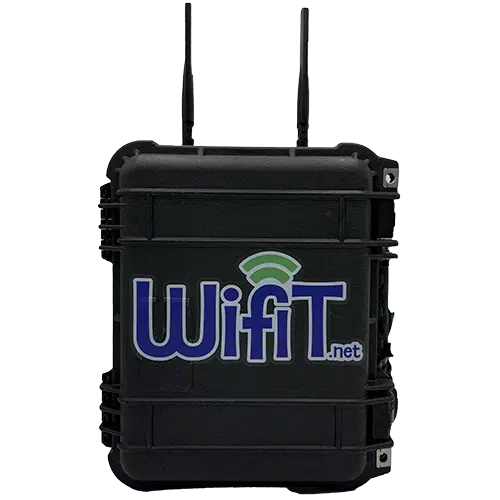
Ideal for trade shows, check-in / registration desks, POS systems, meetings, and conference breakout rooms.

Ideal for site offices, trade shows, conferences, silent auctions, guest networks, and live streaming.

Ideal for any location with an unobstructed sky view or remote locations with limited cellular signal.

Ideal for trade shows, large conventions, outdoor events & big venue spaces, festivals, and popup locations that need custom solutions.





Utah’s events don’t stay in one place. A single corporate client might open a product launch at the Salt Palace Convention Center in Salt Lake City, run a leadership retreat at a Park City ski lodge at 7,500 feet, and close with a partner dinner at Thanksgiving Point in Lehi — all in the same week. Standard venue WiFi can’t follow that schedule. WiFiT deploys independent bonded cellular and satellite-hybrid internet that travels with the event, engineered for each specific venue type rather than a generic convention-hall baseline.
The Salt Palace Convention Center in downtown Salt Lake City anchors Utah’s largest convention market, with over 515,000 square feet of contiguous exhibit space and a schedule that stays packed from January through October. The Mountain America Expo Center in Sandy adds a second major venue south of the city, handling trade shows, consumer expos, and mid-size corporate events throughout the year. North of Salt Lake, the Ogden Eccles Conference Center serves the Weber County market, while the Provo Marriott Conference Center and UCCU Center at Utah Valley University anchor Utah Valley’s growing event calendar.
Then there’s the Silicon Slopes corridor — the stretch of tech-company headquarters and startup campuses running from Lehi through Draper toward Salt Lake. Company all-hands events, investor days, and product launches at Thanksgiving Point’s venues, Adobe’s Utah campus, and the sprawling office parks along Bangerter Highway pull audiences of 500 to 5,000 with device densities that match tech-conference norms in San Francisco or Austin. The house WiFi at these venues was never designed for that load.
Salt Lake City’s downtown core hosts Utah event WiFi demands at the highest scale the state sees. The Salt Palace Convention Center runs multi-day trade shows and consumer expos back-to-back — the Utah Outdoor Retailer gatherings, FanX Salt Lake Comic Convention, and major healthcare and tech industry events all push the venue’s wireless infrastructure toward its limits during peak floor hours. A trade show with 800 exhibitor booths, 30,000 attendees, and sponsor activations running cloud-based demos can generate 50,000 or more simultaneous device associations. That’s not a demand any shared house network was designed to absorb. For deployment details specific to downtown venues, see our dedicated Salt Lake City event WiFi page.
WiFiT deploys dedicated Utah event internet at Salt Palace with multi-carrier bonded uplinks on Verizon, AT&T, and T-Mobile — private SSIDs for exhibitors, operations, and press entirely separate from any venue infrastructure. The Delta Center, home of the Utah Jazz and a major concert and event venue, presents a similar challenge: dense seating, concrete RF absorption, and sponsorship zones that each need their own reliable connectivity for POS terminals and activation equipment. For exhibitors and sponsors who can’t have their systems go dark mid-morning, our dedicated trade show internet setup eliminates that risk.
Park City is Utah’s most demanding event WiFi environment for a different set of reasons. At 6,900 to 9,000 feet elevation, cellular signal propagation behaves differently than at valley altitudes. Topography — ridgelines, canyon walls, and dense ski-run terrain — creates shadow zones where carrier coverage drops off entirely. The canyon corridors between Salt Lake City and Park City (State Route 224 and Interstate 80 through Parley’s Canyon) limit LTE and 5G to a handful of towers that saturate quickly during major events.
The Sundance Film Festival draws international press, filmmaker crews, and industry attendees to Park City every January. Screenings happen across the MARC, Eccles Theatre, and a collection of satellite venues on Main Street and in Kimball Junction. Press upload deadlines, streaming Q&As with remote participants, and credentialing systems all demand uplinks that the Park City resorts and event spaces simply cannot provide at festival scale. WiFiT deploys bonded cellular and Utah satellite internet together at these events — Starlink provides a ground-truth baseline uplink regardless of how congested the local cell towers become during the festival’s peak days.
Ski resort conferences and corporate incentive retreats at Deer Valley, Park City Mountain, and Alta operate year-round, with winter events facing the additional constraint that heavy snowfall and ice affect equipment placement and power logistics. Our mountain venue deployments use weatherized enclosures and thermal-stable hardware rated for sub-zero exposure — the gear that keeps networks running when a February storm rolls in mid-event.
Utah’s outdoor event calendar ranges from Red Rock Festival-style gatherings near Moab to country fair events at the Utah State Fairpark in Salt Lake, to outdoor corporate days at Liberty Park and the Gallivan Center downtown. Each presents a distinct RF environment. Open desert terrain near southern Utah’s national parks — Zion, Arches, Bryce Canyon — has minimal cellular infrastructure for miles in any direction. Canyon geography between cliff walls creates multipath RF reflections that make standard hotspot deployments unreliable even where signal technically exists.
For outdoor Utah event internet in these conditions, WiFiT defaults to Starlink satellite as the primary uplink, bonded with any available cellular signal as a secondary path. The dish needs a clear sky window of roughly 100 degrees — achievable even in deep canyon settings with careful positioning. At elevation, equipment must handle temperature swings of 40 to 50 degrees Fahrenheit between morning setup and afternoon peak. Our outdoor rigs are rated for these conditions. Consumer-grade access points and hotspots are not — they throttle at 95°F and fail when temperatures drop below 32°F during extended outdoor operation.
Moab’s growing event scene — including mountain bike festivals, trail running events, and outdoor industry gatherings — sits in a cellular dead zone category that requires satellite-primary planning for any event with more than 50 people who need reliable connectivity. For more on what outdoor venues require, see our outdoor event WiFi resource.
The Lehi-to-Draper corridor hosts some of Utah’s most technically demanding event WiFi requirements. Investor days at companies in the Silicon Slopes corridor routinely involve simultaneous video feeds to remote shareholders, live financial data systems, and credentialing platforms for hundreds of attendees. A 600-person all-hands at a tech campus in Lehi expects bandwidth performance equivalent to what attendees get at their own desks — not the shared guest WiFi of a hotel banquet floor.
Thanksgiving Point’s venues — the Museum of Natural Curiosity, the Farm Country barns, and the outdoor gardens — host a wide mix of corporate events, galas, and consumer festivals. The property spans 55 acres, and events often use multiple buildings simultaneously. WiFiT covers multi-building deployments with distributed access point infrastructure and a single managed backhaul — your event has one network that spans the entire property, not three separate hotspots that guests have to switch between.
Provo and the broader Utah Valley market support a heavy calendar of university events, academic conferences, and regional trade shows. BYU’s Marriott Center hosts concerts, commencement ceremonies, and large-scale campus events. The UCCU Center at Utah Valley University handles mid-size concerts and graduations. Both venues operate with house AV and IT infrastructure designed for their core use cases — neither was built to support the device density of a 12,000-person concert crowd all streaming at once.
Temporary Utah event internet deployments at Provo venues use the same multi-carrier bonding approach as Salt Lake events. Provo’s cellular infrastructure is mature, giving us strong AT&T and Verizon signal to bond against. For events at the Provo Marriott or the Utah County Convention Center, WiFiT provides a dedicated circuit that your event controls — separate from anything the venue shares with its other guests or tenants.
Ogden’s event market centers on the Ogden Eccles Conference Center, the McKay Events Center at Weber State University, and the historic Union Station event space. The Ogden Amphitheater downtown draws outdoor concerts through the summer months. St. George, in Utah’s southwest corner, serves as the hub for Dixie State events, outdoor adventure festivals, and corporate retreats escaping winter weather. WiFiT covers both markets with the same on-site engineering model — equipment ships to the venue, network engineers set up and monitor through the event, and gear strikes when the program ends.
Utah has become a major destination wedding market, with venues like Sundance Mountain Resort, The Lodge at Bridal Veil Falls in Provo Canyon, Snowbird’s Summit Reception Center, and the Zermatt Resort in Midway drawing couples and guests from across the country. The connectivity challenges at these properties are predictable: remote locations with limited cellular, house WiFi specified for lodging guests rather than 200-person event crowds, and programs that include live ceremony streaming for guests who couldn’t travel.
WiFiT’s wedding WiFi deployments at Utah venues use bonded cellular for any location with usable 4G or 5G signal, Starlink as primary for venues in canyon or mountain terrain beyond cell range, and VLAN-separated networks for guests, the photography and videography team, and the coordinator’s operational systems. The stream uplink gets a dedicated allocation — separate from guest browsing — so a bandwidth spike on the guest network doesn’t affect the ceremony broadcast.
Every WiFiT deployment includes standard security configuration: WPA3 encryption on all SSIDs, VLAN isolation between network segments, and firewall rules that keep attendee traffic from reaching operational or production systems. For events with PCI-scope payment processing — trade show exhibitors, festival concession systems, gala ticket scanners — we configure the payment network segment to comply with isolation requirements rather than running card data across a shared general-access SSID.
Production support for live broadcasts, hybrid meetings, and streaming events includes a dedicated uplink allocation with reserved bandwidth for your encoder or video conferencing platform. We account for upstream bandwidth requirements specifically — standard bonded cellular configurations provide 50 to 150 Mbps upload depending on carrier signal conditions at the venue, which covers most production uplink requirements. For events needing guaranteed upload floors, Starlink adds a parallel uplink path that holds through cellular congestion.
WiFiT has been deploying temporary internet across Utah since 2015. The operating model is consistent regardless of venue scale or type: industrial-grade bonded cellular hardware shipped ahead of your event date, configured for the actual device load and bandwidth profile your program requires, with on-site network engineers who stay through the duration and adjust the network in real time as conditions change. Multi-carrier bonding across Verizon, AT&T, and T-Mobile eliminates the single-point failures that down venue-provided WiFi mid-event. Satellite-hybrid configurations add a parallel uplink path for venues where cell coverage is thin.
From a 40,000-attendee expo week at the Salt Palace to a 75-person partner retreat at a Deer Valley ski lodge, the engineering approach scales to the event. Pricing varies by venue, duration, device count, network segmentation requirements, and whether satellite deployment is needed — request a quote with your event date and location for a specific estimate.
WiFiT delivers dedicated temporary internet to Utah events of every scale — from multi-day trade shows at the Salt Palace Convention Center to outdoor festivals at Thanksgiving Point to mountain retreats in Park City. Utah’s geography demands more from event connectivity than flat convention-hall deployments: altitude affects cellular propagation, canyon terrain creates coverage gaps, and ski-resort venues face winter conditions that standard hotspot hardware isn’t rated to handle. Our bonded cellular and satellite-hybrid systems are engineered for the full range of Utah venue conditions, not just optimal indoor environments.
Every Utah event WiFi deployment includes on-site network engineers for the event duration, multi-carrier bonded uplinks, VLAN-isolated network segments for attendees, staff, and production, and weatherized outdoor equipment where the event runs outside. Whether you need WiFi rental for a 300-person corporate gala in Salt Lake City, a 5,000-attendee consumer expo in Sandy, or a remote Moab adventure event with no cell coverage for miles, WiFiT provides the infrastructure and the engineering support to keep the network running through the last session.
We cover the entire state. Our primary Utah markets include Salt Lake City and the greater Wasatch Front (Sandy, Murray, South Jordan, Draper), the Silicon Slopes corridor from Lehi through Orem and Provo, Park City and Summit County, Ogden and Weber County, St. George and Washington County, and rural venues including Moab and locations adjacent to Utah’s national parks. Equipment ships to your venue with on-site engineers included for the full event duration.
Yes. The Salt Palace is one of our most active Utah venues. We deploy dedicated bonded cellular internet with private SSIDs for exhibitors, press, and operations — entirely independent of the venue’s house network. Multi-carrier bonding across Verizon, AT&T, and T-Mobile gives us redundant uplinks so a single carrier’s congestion during peak floor hours doesn’t affect your event’s connectivity. We support everything from small corporate conferences to large multi-day trade shows at Salt Palace.
Park City mountain venues require more planning than valley locations. At 7,000 to 9,000 feet elevation, cellular coverage is limited to a small number of towers, and canyon topography creates shadow zones. We typically deploy a combination of bonded cellular and Utah satellite internet at Park City events to provide a reliable baseline uplink that doesn’t depend entirely on how congested the local cell towers are. Our outdoor equipment is rated for sub-zero winter temperatures and weatherized for snow exposure — requirements that matter for January and February events during ski season.
Yes. Thanksgiving Point’s venues — the gardens, museum spaces, and event pavilions — span a large property where events often run across multiple buildings simultaneously. We deploy distributed access point infrastructure with a single managed backhaul, covering the full property under one network that your event team controls. The Silicon Slopes cellular infrastructure in Lehi gives us good carrier bonding options, and we add Starlink backup for outdoor events at the gardens where signal through tree canopy can be inconsistent.
Yes. Sundance events are a recurring deployment for us. The festival uses venues across downtown Park City and Kimball Junction simultaneously — press rooms, screening venues, industry lounges, and filmmaker hospitality spaces all need reliable uplinks for credential systems, upload deadlines, and streaming Q&As. We deploy bonded cellular with Utah satellite internet as a parallel uplink to handle the heavy cellular congestion that builds on the Park City network during festival peak days in January.
Altitude affects cellular signal propagation and equipment thermal behavior. At Park City or Alta elevations, fewer carrier towers are within line of sight, and the towers that exist saturate faster when a large event brings thousands of devices into a small geographic area. Temperature swings between early morning setup and afternoon operation can exceed 40°F, which affects hardware that isn’t rated for the full range. WiFiT’s mountain venue deployments use equipment tested at elevation and weatherized for temperature and precipitation exposure. Satellite Internet serves as a ground-truth uplink path that altitude doesn’t affect.
Yes — Utah satellite internet via Starlink is one of our most-requested services, particularly for Park City mountain venues, Moab outdoor events, and rural southern Utah locations near Zion or Bryce Canyon where cellular coverage is sparse or nonexistent. Our Utah Starlink rental service delivers 100 to 300+ Mbps download speeds anywhere with a clear sky view, completely independent of local cell tower coverage. Setup takes roughly 15 minutes on-site and works across the full state. For valley events with strong 5G coverage in Salt Lake City, Provo, or Ogden, we often bond Starlink with cellular for a redundant dual-path uplink rather than relying on either alone.
For a 500-person corporate event with standard usage — laptops on video calls, phones browsing and sharing, a presentation system on AV — we typically provision 200 to 400 Mbps aggregate depending on the program. Bonded cellular at a Wasatch Front venue with strong multi-carrier coverage provides that range reliably. If your event includes large file uploads, broadcast-quality streaming, or dense exhibitor cloud systems running simultaneously, we size up accordingly. Request a quote with your venue and program details for a specific bandwidth recommendation.
Pricing depends on attendee count, event duration, venue type (indoor vs. outdoor), and whether satellite deployment is required. Most indoor corporate event WiFi for 100 to 300 attendees at a Salt Lake City or Provo venue runs $900 to $2,200 per day. Outdoor deployments requiring Starlink, mountain venue events in Park City, or events with production streaming requirements typically run $1,500 to $3,500. Multi-day events and large trade shows are quoted by the full run rather than per-day rates. We provide itemized quotes with no surprise fees added on event day.
Yes — network segmentation is standard on every deployment. We configure separate SSIDs with independent bandwidth pools for general attendees, exhibitors or sponsors, staff and operations, and any production or broadcast team. Each segment runs on its own VLAN, so a bandwidth spike on the attendee network doesn’t affect the production stream, and sponsor demo equipment on the exhibitor network stays isolated from attendee traffic. We can label each SSID with your event branding or keep them generic — your choice.
Yes. Events near Zion, Arches, Bryce Canyon, and Capitol Reef are in cellular dead zones or near-dead zones by definition — cell tower density in southern Utah’s canyon country is minimal. WiFiT deploys Starlink as the primary uplink for any event in these areas. The dish needs a clear sky window of about 100 degrees, which is achievable with careful positioning even in canyon settings. We conduct a site assessment to determine optimal placement before equipment ships. Moab, Kanab, and Torrey events fall into this category regularly.
Yes. Provo is fully within our Utah event WiFi service area. We support events at BYU’s Marriott Center, the UCCU Center at Utah Valley University, the Provo Convention Center, and hotel conference facilities throughout Utah County. BYU events range from academic conferences to large commencement ceremonies and campus entertainment — we’ve handled the full size range. Provo’s cellular infrastructure gives us strong bonding options on both AT&T and Verizon for valley-floor venues.
For events under 300 attendees with standard indoor requirements, one to two weeks lead time is generally sufficient. For large trade shows at the Salt Palace, multi-venue deployments, or any event requiring Starlink logistics in a remote Utah location, three to six weeks gives us proper planning time for site assessment, equipment staging, and carrier pre-positioning. Urgent requests are welcome — call us at +1 (855) 304 0303 and we’ll tell you what’s achievable on your timeline.
Yes. Our outdoor hardware is rated for sub-zero ambient temperatures and weatherized for precipitation exposure. Standard consumer access points fail in freezing temperatures during extended outdoor operation — their operating-temperature floors are typically 32°F, and condensation from snowfall causes hardware failures. WiFiT’s mountain venue deployments use weatherized enclosures with thermal management appropriate for Utah winter conditions. We’ve operated through February events in Park City and Alta without cold-weather equipment failures.
Yes. The Delta Center hosts Utah Jazz games, concerts, and large-scale corporate events with attendance often exceeding 18,000. Arena events create extremely high device density in a concrete-heavy RF environment. For sponsor zones, production operations, and hospitality areas that need reliable connectivity independent of the venue’s shared infrastructure, WiFiT deploys a dedicated bonded cellular circuit sized for your specific operational requirements at the venue.
Yes. Live streaming requires consistent uplink bandwidth — the requirement that shared venue WiFi most reliably fails to deliver under event load. WiFiT allocates a dedicated uplink reservation for your production encoder, isolated from general attendee traffic. Whether your stream goes to 200 remote viewers on Zoom or 20,000 on YouTube Live, we plan the uplink bandwidth to match the bitrate requirements of your destination platform. Bonded cellular provides 50 to 150 Mbps upload in most Utah Wasatch Front locations; Starlink adds a parallel uplink path for redundancy or for venues where cellular upload is constrained.
Outdoor RF management requires active planning rather than passive deployment. At large events, unmanaged hotspots from sponsors, exhibitors, and vendors create co-channel interference that degrades performance for everyone on adjacent frequencies. WiFiT controls our access point infrastructure’s channel selection and transmission power to maintain clean signal to connected devices. For events where 2.4 GHz and 5 GHz congestion is severe — outdoor festivals at Liberty Park or Gallivan Center during summer, for instance — we use WiFi 6E equipment operating in the 6 GHz band, which is entirely clear of the congestion that builds in the legacy bands.
Yes. Mountain America Expo Center in Sandy is one of our regular Utah venues. The Expo Center handles consumer expos, trade shows, and corporate events that push attendee WiFi demand beyond what the venue’s shared infrastructure was designed for. We deploy independent bonded cellular internet with private SSIDs — exhibitors get their own network segment isolated from general attendee browsing, and operations get a third segment dedicated to event management systems. Sandy’s cellular coverage from multiple carriers gives us strong bonding performance at this venue.
Yes. Utah destination wedding venues — Sundance Mountain Resort, Snowbird’s Summit Reception Center, Zermatt Resort in Midway, The Lodge at Bridal Veil Falls — share a common connectivity challenge: remote or semi-remote locations with cellular coverage that wasn’t designed for event-scale device loads, and house WiFi specified for lodging guests rather than 200-person ceremony crowds. WiFiT’s wedding WiFi rental provides dedicated bonded cellular or Starlink uplink, VLAN-separated guest and vendor networks, and a reserved upload allocation for ceremony streaming. We stay on-site through the reception.
Standard security configuration on every deployment includes WPA3 encryption on all SSIDs, VLAN isolation between network segments, and firewall rules preventing cross-segment traffic. For events with PCI-scope payment processing — trade show exhibitor card terminals, festival concession POS, gala ticket scanning — we configure the payment network segment with isolation appropriate for card data handling. Client login portals and captive portal splash pages with event branding are available as add-ons. Your attendee data stays on your network segment and is not logged or retained by WiFiT after the event.
Yes. Ogden is within our regular Utah service area. We support events at the Eccles Conference Center, McKay Events Center at Weber State, Union Station event space, and the Ogden Amphitheater for outdoor summer events. Ogden’s proximity to the Wasatch Front gives us solid multi-carrier bonding performance for indoor venues. For outdoor amphitheater events in late summer, we plan for variable RF from the surrounding terrain and size uplink capacity to hold through peak crowd hours.
Both options are available. The most common choice is a fully independent network using our own bonded cellular or Starlink uplinks — your event traffic never touches the venue’s infrastructure, and you have complete control over bandwidth allocation and network configuration. Alternatively, we can supplement an existing venue network by adding a separate high-capacity uplink for specific functions — production, exhibitors, or a VIP area — while letting general attendees use the venue’s system. Most event producers at Utah venues with older house WiFi find the independent approach more reliable and cost-effective than paying the venue for upgraded bandwidth tiers.
Yes. St. George and Washington County are within our Utah event internet service area. We cover events at Dixie State University venues, the St. George Convention Center, Zion National Park gateway events, and private venues throughout the area. Southern Utah’s distance from major carrier infrastructure means cellular bonding performance varies more than in the Wasatch Front markets — for events in Washington County and beyond, we assess carrier signal at the specific venue and recommend Starlink as a primary or secondary uplink based on what that assessment shows.
Yes — Utah businesses use WiFiT for temporary office internet during moves, renovations, or while waiting on a permanent ISP install, not just for events. We bring bonded-cellular or satellite kits on-site and have you online same-day, no cabling or long-term contract required. See temporary office internet solution for pricing and setup details. Some Utah clients just call it temporary office WiFi — same setup, same fast turnaround.
“Produced a 2,000-person music festival on the Ogden Amphitheater grounds and needed WiFi for ticketing, vendor POS, and a social media wall. WiFiT handled all of it without flinching. Satellite backup was a smart call given the remote setup.”
“Brought 150 remote employees together at the UCCU Center for an annual company retreat with breakout sessions running video calls all day. Every room had solid signal. The team clearly knew how to configure for a multi-room layout.”
“Our outdoor wedding reception at Thanksgiving Point required reliable WiFi for the live-stream going to family overseas. Everything worked beautifully from cocktail hour straight through the last dance. Could not have asked for better service.”
From the field
A practical guide to why venue WiFi fails at events, the specific failure modes, and the playbook event producers running

Livestream-by-default, hybrid event SSIDs, MSP-led event delivery, satellite as standard redundancy — eight trends reshaping event connectivity heading into 2026.

Discover how Fusion-2, with its unlimited data and easy setup, is the ideal portable WiFi solution for trade show attendees
We offer comprehensive WiFi solutions that can meet all of your needs. Rent now and enjoy seamless connectivity from anywhere!